

 Français
 Русский
 Español
Curtain wall fasteners are the stainless steel anchors, screws, and bolts that fix the facade to the building structure. Though small, they carry the entire facade — glass, frames, and panels — and are nearly impossible to replace once installed. Specifying the right fasteners, in the right grade, with the right torque, is essential for a safe and long-lived curtain wall.
This guide explains the main types of curtain wall fasteners and how to select them.
The Main Types of Curtain Wall Fasteners
Mechanical Anchors
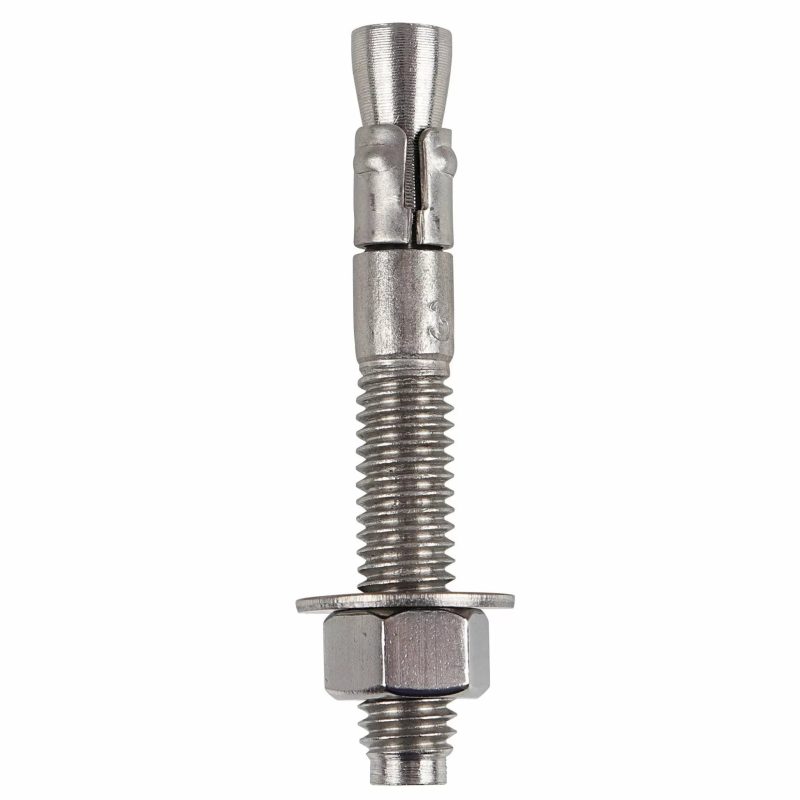
Mechanical anchors (expansion anchors, undercut anchors, and back anchors) fix the brackets to concrete or masonry substrate. They develop load through mechanical interlock or friction. Undercut anchors provide high pull-out resistance and are common for facade fixings.
As an alternative to drilled post-installed fixings, our guide on how to install cast-in channels covers embedding a receiver before the concrete pour.
Self-Tapping / Self-Drilling Screws
Self-tapping screws fasten hardware to aluminium profiles. For aluminium-to-aluminium connections, use stainless steel self-drilling screws that cut their own thread without pre-drilling, reducing bimetallic corrosion risk against the aluminium bracket.
Structural Bolts and Studs
Through-bolts and studs make high-strength connections at brackets, ear plates, and load-bearing nodes, tightened to a specified torque. Bolt grade (e.g., A2-70 or A4-70 stainless) sets the strength and corrosion performance.
When the connection calls for a continuous threaded member rather than a headed stud, see our threaded rod vs stud for curtain walls comparison.
Material Grade: Why It Matters
Exterior facade hardware is exposed to weather cycling for the life of the building, with limited access for maintenance. Stainless steel — especially 316 (A4) in coastal or polluted environments — reduces long-term corrosion and replacement risk enough that it is usually worth the upfront cost premium over mild steel or galvanized hardware on any facade of real height or exposure. Use 304 (A2) for interior and low-corrosion use.
For a consolidated specification review, our specifying facade hardware checklist groups fastener type, grade, torque and material documentation.
How to Select Curtain Wall Fasteners
- Match substrate — concrete and masonry need anchors; aluminium and steel profiles need self-tapping screws or bolts.
- Choose the grade for the environment — 316/A4 for coastal, polluted, or high-exposure; 304/A2 otherwise.
- Avoid bimetallic corrosion — use stainless against aluminium and isolate dissimilar metals where needed.
- Respect the torque window — over-torquing strips threads in aluminium; follow the specified torque (e.g., 30–40 N·m for common M6 self-taps into panel cleats).
- Confirm load ratings — pull-out and shear capacity must cover the facade load, verified by engineering.
Frequently Asked Questions
What grade of stainless steel should curtain wall fasteners be?
Use 316/A4 stainless for coastal, polluted, or high-exposure facades; 304/A2 for interior and low-corrosion environments. A4 bolts and anchors resist corrosion far better over the building’s life.
To select the right alloy for the exposure, our guide to stainless steel grades for facade fixings compares 304/A2 and 316/A4 across environments.
Why do fasteners need a torque specification?
Over-torquing strips the threads in soft aluminium and can over-stress the fastener; under-torquing leaves the connection loose. The manufacturer’s torque window balances grip and thread strength.
Can I use galvanized hardware for a curtain wall?
Not recommended for exposed facades. Galvanized or mild steel corrodes over time and is very hard to replace behind an installed facade. Stainless steel is the safe default.
Get the Right Fasteners for Your Facade
For the wall-side anchor stage of the fastener assembly, our curtain wall fixing anchor selection guide covers anchor bolt choice for concrete and masonry.
Trilonum supplies stainless steel fasteners and bolts, anchors, and brackets for curtain walls and glazing. For the wider picture of where the facade industry is heading, see our trends guide. Contact us for grade and torque guidance on your project.
Specifiers choosing between mechanical and bonded fixings will find our expansion vs resin chemical anchor guide useful.
