


 Français
 Русский
 Español
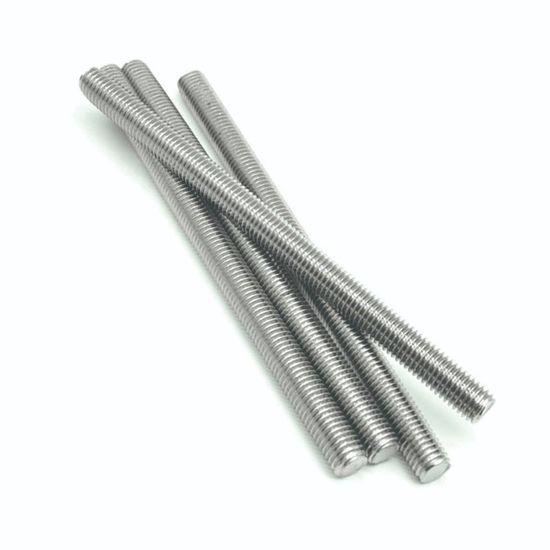
Threaded rods and studs are stainless steel fixings used throughout curtain wall and facade assemblies — as hanging rods, tie-back connections, and tension members that transfer load into the structure. Specifying the right diameter, grade, and finish keeps the connection strong and corrosion-free for the building’s life.
This guide explains how to select threaded rods and studs for curtain wall fixings.
Where Threaded Rods Are Used
- Hanging rods — support framing or brackets from the structure above.
- Tie-back and lateral ties — restrain the facade against wind and movement.
- Tension members — part of tension rod and cable systems for point-supported glass.
- Anchor studs — threaded studs bonded or mechanically fixed into concrete for bracket connections.
Key Selection Factors
- Diameter and length — sized for the tensile and shear load at each connection; full-threaded rods (e.g., to DIN 975) suit adjustable lengths, while partial-thread studs give a defined grip length.
- Material grade — stainless steel 304 (A2) for interior/low corrosion, 316 (A4) for coastal and exposed facades.
- Strength class — match the grade and proof strength to the design load; do not exceed the rated capacity.
- Thread standard — metric (DIN 975/976) and imperial options exist; keep the whole connection family consistent.
- Finish — avoid galvanic corrosion by pairing compatible materials against aluminium and isolating dissimilar metals where needed.
Common Mistakes
- Using a rod grade too soft for the design load.
- Choosing 304 in a coastal or poolside environment where 316 is required.
- Mixing thread standards across a connection.
- Ignoring corrosion between the rod and aluminium components.
Frequently Asked Questions
What is the difference between a threaded rod and a stud?
A threaded rod is fully threaded along its length and can be cut to size for adjustable connections; a stud is threaded at one or both ends with an unthreaded grip section, often used as an anchor or tie with defined grip length.
For the selection decision itself, our threaded rod vs stud for curtain walls comparison lays out thread length, grip section and typical application for each.
What stainless steel grade should threaded rods be?
Use 304 (A2) for interior or low-corrosion use and 316 (A4) for coastal, poolside, or high-exposure facades to prevent corrosion in the load path.
Can threaded rods carry tension loads in curtain walls?
Yes — full-threaded rods are used as tension members in tension rod systems for point-supported glass. The diameter and grade must be sized for the applied tension with a safety factor per design.
Get the Right Rods for Your Connection
When sizing threaded rods, also verify the substrate anchors; our curtain wall fixing anchor selection guide covers expansion and chemical fixing options.
Trilonum supplies bolts, anchors, and brackets plus fasteners for curtain walls, in 304 and 316. For choosing fixings, see our curtain wall fasteners guide. Contact us for rods and studs matched to your connection loads.
Beyond rod and stud connections, our expansion vs resin chemical anchors comparison helps decide the fixing method itself.
