

 Français
 Русский
 Español
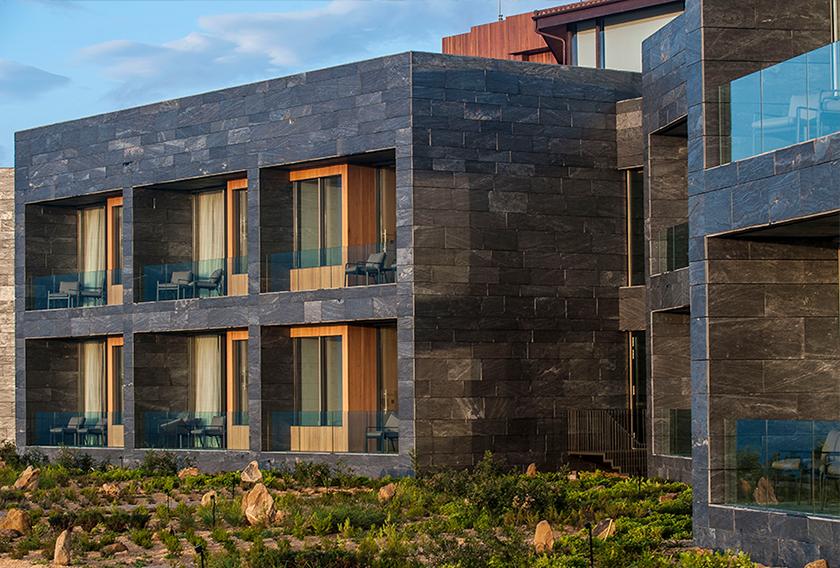
Stone cladding anchors are the stainless steel fixings that hold natural stone panels to a ventilated facade. They carry the panel’s dead weight and, depending on the system, resist wind and seismic loads. Choosing the right anchor type is a structural decision — the wrong one can cause panels to crack, loosen, or fail at the edge.
This guide explains the main types of stone cladding anchors and how to select the right one for your facade.
The Main Types of Stone Cladding Anchors
Z-Brackets
Z-brackets are L-shaped stainless steel profiles with a returned leg that hook into a kerf cut along the stone panel edge. They are simple to install and fully concealed once the joint is sealed, giving a clean finished face. Z-brackets are a common, economical choice for ventilated stone facades, but they need an accurately machined kerf to a specified depth and width.
L / Clip / Shelf-Angle Anchors
Clip or shelf-angle anchors support the panel’s dead load with short, thick L-shaped clips. The vertical leg is anchored to the building frame and the horizontal leg supports the stone. These are widely used to carry gravity loads and are often combined with other fixings for lateral restraint.
Undercut Anchors
Undercut anchors are set into an undercut hole drilled from the panel face, developing high pull-out resistance. They are the preferred choice for slabs below 30 mm and for projects in high seismic zones, because they distribute the reaction over a larger bearing area and reduce the risk of edge breakout.
Comparison at a Glance
| Anchor Type | Best For | Load Role | Notes |
|---|---|---|---|
| Z-Bracket | Ventilated facades, economical | Dead load support | Needs accurate kerf; fully concealed |
| L / Clip / Shelf | Gravity support | Dead load | Thick L-shaped clip; often combined with lateral fixings |
| Undercut Anchor | Slabs <30mm, high seismic | Pull-out / lateral | High resistance; distributes load over larger area |
How to Choose the Right Anchor
- Panel weight and size — heavier, larger panels load each anchor more and may need stronger systems.
- Stone thickness — slabs below 30 mm generally call for undercut anchors; thicker stone suits kerf and bracket systems.
- Substrate — whether the back-up is concrete, steel, or masonry changes the anchor and fixing method.
- Seismic and wind exposure — high seismic zones favour undercut anchors for their better edge-breakout resistance.
- Material grade — use stainless steel (316 for coastal/polluted exposure) to avoid corrosion that weakens the fixing over time.
Final anchor specification should always be confirmed against project drawings, panel weight, substrate condition, and local engineering requirements.
Frequently Asked Questions
What is the difference between a Z-bracket and an undercut anchor?
A Z-bracket hooks into a kerf along the panel edge and mainly carries dead load; an undercut anchor sits in an undercut hole drilled from the face and gives high pull-out and seismic resistance. Use undercut for thin slabs and high seismic zones.
Can I use mild steel anchors for stone cladding?
Exposed facade hardware should be stainless steel. Mild steel or galvanized fixings corrode over the building’s life and are hard to replace once the facade is installed — 304 or 316 stainless is the safe default.
For matching the alloy to the facade environment, our stainless steel grades for facade fixings guide explains where 304/A2 suffices and where 316/A4 is required.
Do stone cladding anchors need a seismic rating?
In high seismic zones, anchors must resist lateral loads and edge breakout. Undercut anchors are preferred there because they distribute the reaction over a larger bearing area.
Specify Anchors for a Safe Stone Facade
Trilonum supplies anchors and brackets for stone cladding and point-supported facade hardware in 304 and 316 stainless. Contact us to match anchors to your panel weight and substrate.
