
 Français
 Русский
 Español
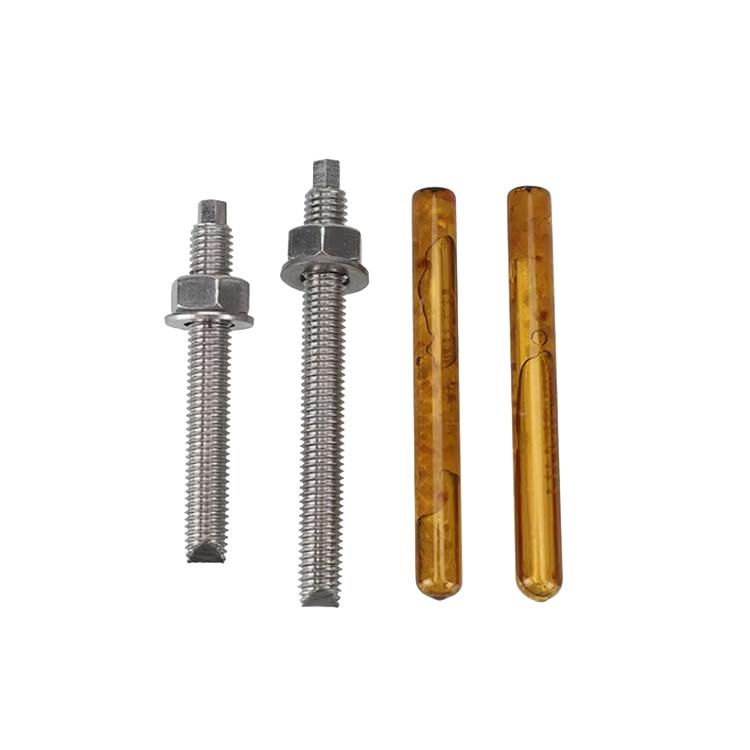
Curtain wall anchor bolts fix the facade brackets to the concrete or masonry structure, transferring the entire facade load into the building. There are two broad families: mechanical expansion anchors, which grip through friction and interlock, and chemical anchors, which bond with resin. Choosing between them is a structural and practical decision.
This guide compares expansion and chemical anchor bolts for curtain walls and explains how to select the right type.
Mechanical Expansion Anchors
Mechanical expansion anchors develop load through the wedge or sleeve expanding against the concrete when tightened. Common types include wedge anchors, sleeve anchors, and drop-in anchors. Undercut anchors are a high-performance variant that interlock mechanically. They install quickly with no curing time and are removable, but they depend on the concrete quality at the embedment and need more edge distance than chemical anchors.
Chemical (Resin) Anchors
Chemical anchors bond a threaded stud into a drilled hole with resin — typically epoxy, vinyl ester, or polyester. They give high bond strength, suit shallow edge distances and cracked concrete, and work well in demanding structural connections. The trade-off is that they need curing time before load, and installation quality (hole cleaning, resin handling) strongly affects performance.
Comparison at a Glance
| Factor | Expansion Anchor | Chemical Anchor |
|---|---|---|
| Load mechanism | Friction / mechanical interlock | Bond with resin |
| Install time | Immediate, no curing | Needs curing time |
| Edge distance | Needs more edge clearance | Works in shallow edges |
| Cracked concrete | Can be limited | Suitable |
| Removability | Removable | Permanent |
How to Choose for a Curtain Wall
- Substrate condition — cracked or low-quality concrete favours chemical anchors.
- Edge distance and spacing — tight edge conditions call for chemical anchors.
- Load and structural rating — both can be engineered to suit the facade load; confirm the rating and test evidence.
- Installation access — where fast, dry installation matters, expansion anchors win; where the connection is critical, chemical may be specified.
- Material grade — use 304 (A2) or 316 (A4) stainless to avoid corrosion in exposed or coastal facades.
Specifications should be confirmed by a qualified engineer and follow the anchor manufacturer’s installation and load data.
Frequently Asked Questions
Which is stronger: expansion or chemical anchor?
Chemical anchors generally give higher bond strength and handle shallow edge distances and cracked concrete better, but they require curing time. Expansion anchors install instantly but need more edge clearance. The right choice depends on the substrate and installation conditions.
Do curtain wall anchor bolts need to be stainless steel?
For exposed or coastal facades, yes — use 304 (A2) or 316 (A4) stainless to prevent corrosion in the load path over the building’s life.
Can I use one anchor type everywhere on a facade?
Not necessarily. Concrete quality, edge distances, and access vary across the facade, so different anchor types are often specified in different zones.
Get Anchor Bolts Rated for Your Facade
Our curtain wall fixing anchor selection guide details how to match expansion and chemical anchors to the substrate and load case covered here.
For a deeper side-by-side, read our comparison of expansion vs resin chemical anchors and when each should be specified.
Trilonum supplies stainless steel fasteners and anchors and related bolts and brackets for curtain walls. For a broader view of facade fixings, see our curtain wall fasteners guide. Contact us for anchors matched to your substrate and load.
