

 Français
 Русский
 Español
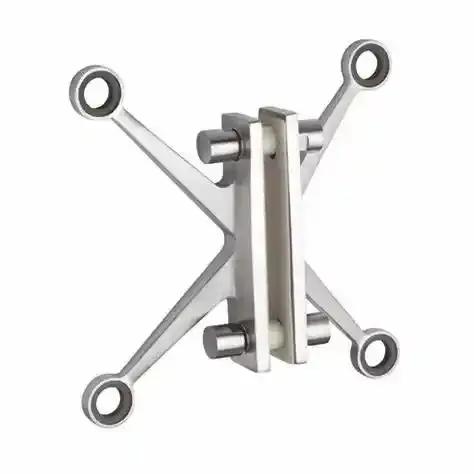
Brackets and ear plates are the stainless steel connection hardware that tie a curtain wall or glass facade to the building structure. Brackets transfer the facade loads to the substrate, while ear plates form the load-bearing nodes that connect spider fittings, tension systems, and glass fins. Small in size, they are critical to structural safety.
This guide explains the main types of curtain wall brackets and ear plates and how to select them.
The Main Types
Anchor Brackets
Anchor brackets fix the curtain wall framing or mullions to the concrete or steel structure. They provide the three-dimensional adjustment needed to align the facade and transfer load to the building. They are usually stainless or galvanized steel, sized and drilled to suit the anchor bolts.
Ear Plates
Ear plates are the steel plates that form the node where structural hardware connects — for example, where a spider fitting, tension rod, or glass fin attaches to the support structure. Their hole pattern and thickness must match the connected hardware and carry the node’s load.
Fin Clamps and Spider Brackets
Glass fin clamps secure glass fins to panels or to the structure, while spider brackets hold the glass at point nodes. These combine the role of bracket and connection, and are specified for their load rating and glass thickness range.
How to Select Brackets and Ear Plates
- Match the load — confirm the bracket or plate carries the node load (glass weight, wind, seismic) for your span.
- Check the hole pattern — ear plates must align with the fixing holes of the connected spider fitting or tension rod.
- Ensure adjustability — anchor brackets should allow the three-dimensional alignment needed during installation.
- Choose material grade — 304 for interior/low corrosion, 316 for coastal and high-exposure facades.
- Verify the fixing — the bolts and anchors connecting the plate to the structure must be rated for the same load.
Frequently Asked Questions
What is the difference between a bracket and an ear plate?
An anchor bracket fixes the facade framing to the building and provides alignment; an ear plate forms the load-bearing node where hardware like a spider fitting or tension rod connects. Bracket ties to structure; ear plate carries the connection point.
What material should curtain wall brackets be?
Exposed and load-bearing brackets should be stainless steel — 316 for coastal or polluted exposure, 304 otherwise. Corrosion in a load path compromises safety over time.
Assemble brackets, anchors and grade on one sheet using our specifying facade hardware checklist for facade hardware.
Can ear plates be custom-drilled?
Yes — ear plates and brackets are commonly custom-sized and drilled to match the connected hardware’s hole pattern and the project’s load requirements.
Get Brackets and Ear Plates That Fit the Load
Once brackets and ear plates are specified, pair them with the correct anchors using our curtain wall fixing anchor selection guide.
Trilonum supplies brackets and ear plates plus point-supported hardware like spider fittings, in 304 and 316. Contact us for custom-drilled plates matched to your connection hardware.
