

 Français
 Русский
 Español
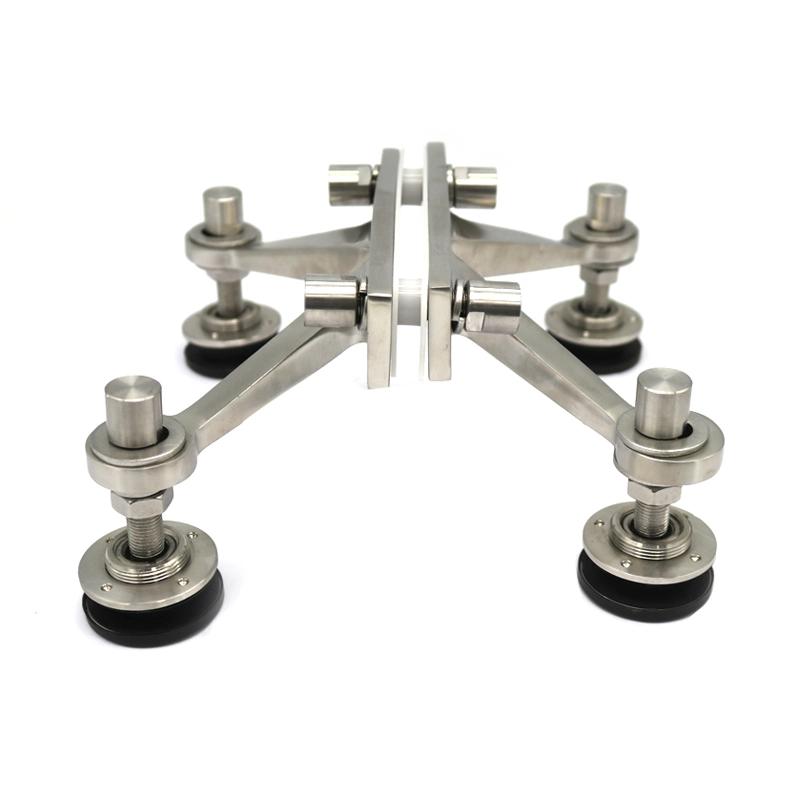
Spider fittings (also called glass spiders) are the stainless steel connectors that hold glass panels together in point-supported curtain walls. A single spider fitting transfers the load of the surrounding glass panels into the supporting structure, so its dimensions and load capacity directly determine whether a facade is safe and stays flat.
This guide explains the key dimensions to check when specifying spider fittings and how load capacity is assessed.
What a Spider Fitting Looks Like
A spider fitting has arms radiating from a central hub — typically two, four, or six arms — each arm holding the corner of an adjacent glass panel. The most common is the 4-arm spider, used where four glass panels meet. The arms bolt to the glass through drilled holes or hold it with clamp plates, while the fitting itself is fixed back to the structure.
Where the arm meets the drilled hole, compare routel bolts and standard fixings to choose the right barrel and shank for panel thickness and load point.
Key Dimensions to Check
- Arm length and reach — the distance from the central hub to the glass mounting hole. It sets the gap the spider bridges and must match your glass panel geometry. Values vary by model; for example, a common 4-arm spider has a total width around 280 mm with a specific centre-to-centre distance between fixing holes.
- Centre-to-centre hole distance — the distance between opposite or adjacent glass fixing holes. This determines whether the fitting aligns with the drilled hole pattern in your glass.
- Arm thickness and height — the material thickness of the arms, which contributes to bending strength under load.
- Number of arms — 2-arm (edge), 4-arm (corner), or 6-arm (junction) depending on how many panels meet at the node.
- Glass thickness range — the panel thickness the fitting can securely hold or that its bolts suit.
Because dimensions vary between manufacturers, always verify the fitting’s dimensions against the drilled hole pattern in your specified glass before ordering.
Load Capacity: What Drives It
The safe load of a spider fitting depends on the fitting’s material, geometry, and the load case, not on a single number. The factors a specifier must consider:
- Glass weight — larger, thicker, or laminated panels weigh more and load each fitting more.
- Wind load — the dominant load on high-rise facades; wind pressure increases with height and exposure.
- Span between supports — the area of glass each fitting supports grows with panel size, increasing the load per fitting.
- Material grade and strength — 304 and 316 stainless have slightly different properties; cast fittings follow standards such as ASTM A743, and bending strength is typically calculated to a recognised method.
Manufacturers rate fittings with a safe load per fitting (for example, a rated safe load around 150 kg per fitting for a standard 4-arm spider, verified by engineering). Treat any published figure as the working capacity for a defined load case and confirm it against your project’s engineering.
304 vs 316 Stainless for Spider Fittings
304 stainless is the default for interior and low-corrosion environments. For coastal, industrial, or high-exposure facades, specify 316 stainless for better corrosion resistance — critical in load-bearing hardware where corrosion would compromise strength over time.
How to Specify Spider Fittings
- Confirm the number of arms and the hole pattern needed for your glass layout
- Verify dimensions (arm length, centre-to-centre, thickness) match the glass drilling
- Confirm glass thickness range compatibility
- Provide the load case to the supplier (glass weight, wind, span)
- Choose 304 or 316 by environment; select finish
- Request the load rating or engineering report for the fitting
Frequently Asked Questions
How much weight can a spider fitting hold?
A typical 4-arm stainless spider fitting has a rated safe load around 150 kg per fitting, but the real capacity depends on glass weight, wind load, and span. Confirm the rating against your project’s load case.
How do I know what size spider fitting I need?
Measure the distance between the drilled holes in your glass and match the fitting’s centre-to-centre dimension and arm length to that pattern. Check the fitting’s glass thickness range too.
Are 304 or 316 spider fittings better?
304 suits interior and low-corrosion use; 316 is required for coastal and high-exposure facades because it resists corrosion that would weaken load-bearing hardware.
Specify Load-Rated Spider Fittings
To place spider fittings within the broader point-support range, our glass fin vs spider system guide compares spiders against glass fins for facade support.
Trilonum supplies stainless steel spider fittings as part of our point-supported curtain wall hardware. We help you match fittings to the glass drilling and load case for a point-fixed curtain wall. Contact us for dimensions and load ratings.
Where spider fittings are specified, engineers can also compare cast-in anchor channel curtain wall options for the supporting embedment.
