


 Français
 Русский
 Español
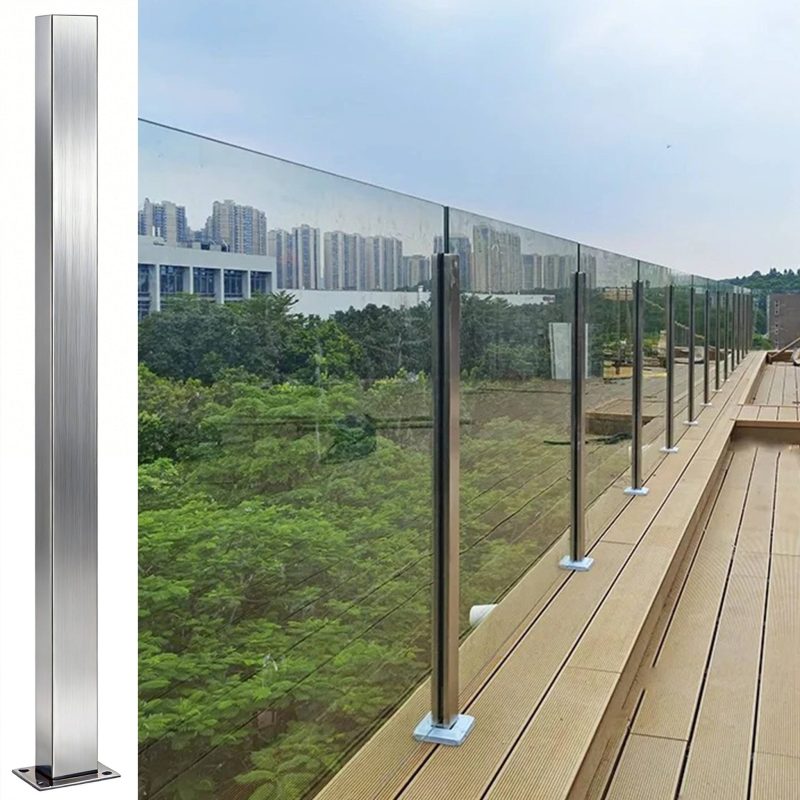
Glass railing posts are the vertical stainless steel supports that carry the panels in post-and-glass balustrades. Choosing the right posts is a balance of height, spacing, glass thickness range, mounting style, and material grade — get it wrong and the railing either fails a load test or looks heavy and out of proportion.
This guide gives a practical selection process for glass railing posts, so you can specify confidently for balconies, stairs, decks, and pool fences.
What Glass Railing Posts Do
In a post-and-panel system, vertical posts are anchored to the deck, concrete, or masonry substrate at regular intervals, and the glass panels are mounted between the posts in channels, clamps, or point-fix hardware. The posts transfer the railing load — including the required barrier load — down to the structure. Their spacing determines the width of each glass panel.
Key Selection Factors
1. Post Height
Match the post height to the required railing height in your local code. Typical finished railing heights range from about 900 mm to 1100 mm depending on application and jurisdiction. The post must reach the full railing height so the glass is supported along its whole edge.
2. Post Spacing
Spacing is driven by three things: the code load requirement, the maximum panel the chosen glass can span without flexing, and the look you want. For residential semi-frameless systems, typical spacing is 4 to 6 feet (about 1.2 to 1.8 m) on centre; commercial systems often run 36 to 60 inches between posts. Wider spacing needs thicker or laminated glass and higher-rated hardware.
3. Glass Thickness Compatibility
Confirm the post’s clamping range covers your glass thickness — commonly 8–12 mm, sometimes 10–12 mm. The glass must fit securely without forcing, trimming, or loosening over time. Thicker, laminated, or taller glass changes the span the post must support.
4. Mounting Style
Posts can be surface-mounted (bolted to the top of the deck or concrete) or embedded (set into the substrate, sometimes with a base channel). Surface mounting is faster and easier to retrofit; embedded mounting gives a cleaner line and higher rigidity. Consider whether your substrate allows drilling and anchoring.
5. End vs Intermediate Posts
End posts and corner posts carry different, often higher, loads than intermediate posts because they take the tension at the run’s termination. Choose stronger or larger posts at ends, corners, and where a handrail terminates or changes direction.
6. Material Grade
304 stainless is the standard for interior and low-corrosion use. For coastal, poolside, or industrial exposure, specify 316 stainless for better corrosion resistance. The finish (satin, mirror, or PVD) affects both appearance and durability.
Selection Checklist
- Confirm required railing height and code load
- Decide spacing (typical 4–6 ft residential, 36–60 in commercial)
- Match the post clamping range to your glass thickness (8–12 mm typical)
- Choose surface-mounted or embedded based on substrate
- Use stronger end/corner posts
- Pick 304 or 316 by environment; choose finish
- Verify anchor type (expansion bolt, epoxy, base channel)
Frequently Asked Questions
What is the standard spacing for glass railing posts?
Typical residential semi-frameless spacing is 4 to 6 feet on centre; commercial runs often 36 to 60 inches. Spacing depends on glass thickness, fixing method, and local load requirements.
What height should glass railing posts be?
Match the post to the required railing height in your code — commonly 900 to 1100 mm finished. The post supports the full panel edge.
Should I use 304 or 316 stainless posts?
Use 304 for interior and low-corrosion use; specify 316 for coastal, poolside, or industrial environments to avoid early corrosion.
Specify Posts That Fit Your Railing
When you have chosen your posts, our glass railing handrail installation guide explains how to mount the handrail on brackets and standoffs, while our spigot vs standoff comparison clarifies the two base-fixing options for point-mounted glass.
Trilonum supplies stainless steel railing posts and full railing and balustrade hardware in 304 and 316, including glass clamps to match. Getting the posts and clamps right also controls what a railing system costs. Contact us for height, spacing, and load guidance.
When posts are not part of the design, our guide to frameless glass railing systems compares U-channel and clamp base fixings in detail.
Before ordering posts and panels, follow our step-by-step guide to measuring for glass balustrades, including posts, panels and tolerances.
