


 Français
 Русский
 Español
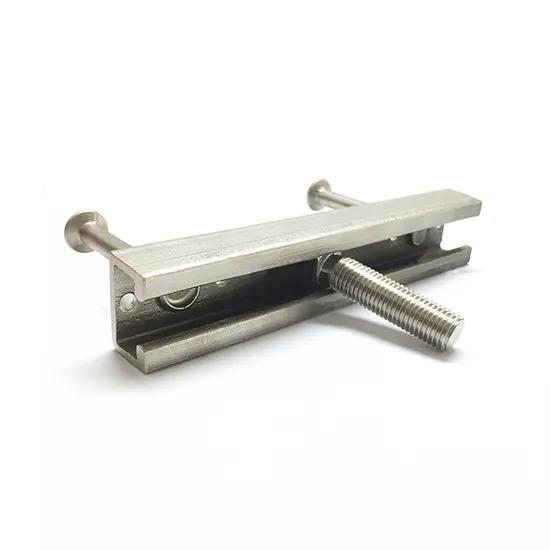
A cast in anchor channel curtain wall detail embeds a slotted steel rail into concrete or precast before the pour, so brackets, mullion supports and spider fittings bolt on later without drilling hardened concrete. Choosing the right cast-in anchor channel is a coordination exercise: section, leg pattern, finish and T-bolt system must match the wind load, substrate and service life. This guide walks engineers and specifiers through the choices that separate a reliable receiver from a fixing drilled out after curing.
On point-supported facades, the channel sits behind the glass and carries spiders, tension-rod end fittings and bracket arms back to the concrete frame. Our point-supported systems range lists the spiders that bolt onto these receivers, and our guide to tension rod and cable hardware explains how bracing terminates at embedded fixings. Weighing an embedded rail against drilled fixings? Our sister guide to curtain wall fixing anchors compares the two.
Retail showrooms rely on this hidden support; see our point-supported retail glazing case study for how a commercial frontage combined embedded channels and spider fixings.
What a Cast-in Anchor Channel Does in a Curtain Wall
A cast-in anchor channel is a C-shaped slotted steel rail held against formwork or tied to the reinforcement cage before pouring. After curing, a T-head bolt or serrated channel nut enters the slot and tightens against the lip; the bracket bolts to that fitting. Buried in concrete, loads pass through the channel into its anchor legs and surrounding concrete, rather than a drilled anchor’s bond alone. The slot also allows lateral adjustment along the rail, absorbing structural-grid tolerances — why detailers prefer it on slab-edge reveals and precast elements.
Hot-Rolled vs Cold-Formed Channels
Channels come in two broad families, and the choice drives capacity, stiffness and cost:
- Hot-rolled channels are rolled steel sections with deeper, stiffer walls; they suit higher load cases and longer spans where stiffness matters.
- Cold-formed (cold-rolled) channels are bent from sheet or strip into lighter sections; they suit lighter brackets, secondary fixings and cost-sensitive runs at modest loads.
- Serrated (toothed) lips grip the T-bolt mechanically under shear; smooth-lip channels rely on bearing and friction for lighter service.
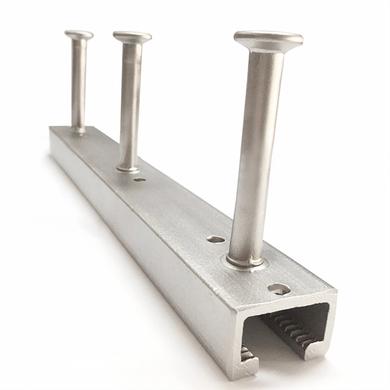
Section depth, slot opening and leg spacing appear in the supplier’s catalogue, and usable capacity must come from that data rather than appearance. A deeper-looking section is not automatically higher-capacity when leg spacing and cover differ.
Material and Surface Finish
The body and legs are usually carbon steel in common structural grades, or stainless for demanding environments. Finishes run from plain black steel for internal dry locations, to zinc plating for moderate exposure, to hot-dip galvanizing for exterior service. Stainless channels and T-bolts — 304 inland, 316 for coastal, pool or aggressive sites — avoid coating replacement at higher cost. Match grade and finish to the exposure class with the supplier.
Anchor Legs: Studs, Welded Bars and Load Transfer
Load-transfer members take common forms: headed studs welded or swaged to the channel back, perpendicular welded bars, or bent legs. Headed studs spread pull-out forces over a larger concrete volume; welded bars suit straight fabrication runs. Leg count, spacing and projection depth are variables in the supplier’s data sheet — under-specifying them cuts pull-out capacity even when the section looks substantial.
Load Cases: Pull-Out, Shear and Moment
A facade fixing rarely sees one clean force. Designers evaluate three directions before selecting a section:
- Pull-out (tension): wind suction lifts the bracket away from concrete; channel and legs must resist breakout.
- Shear: wind pressure pushes the panel outward and sideways; the T-bolt bears on the lip and legs resist sliding.
- Moment: an offset bracket arm creates a turning force the channel and legs must contain without rotating.
Cases combine in practice, so selection uses the supplier’s factored values for section, leg spacing and concrete class — not a generic weight rating. Defer to supplier data and the engineer’s factored combinations.
Cast-In Timing vs Post-Installed Fixing
Cast-in channels are positioned before concrete cures, so timing is critical: the rail aligns to the facade grid and holds against formwork or rebar without shifting during the pour. This suits new construction, precast elements and slab-edge reveals planned on drawings. Where a channel was missed or the design changes after curing, contractors use post-installed expansion or chemical anchors in hardened concrete; these lack along-slot adjustment but need no advance coordination. Never mix both on one load path without engineering review.
For the on-site sequence that follows this placement, our step-by-step guide on how to install cast-in channels covers formwork fixing, alignment, pour sequencing and T-bolt insertion after curing.
T-Bolts, Channel Nuts and Supporting Steel
The channel is only useful with matched fittings. T-head bolts drop into the slot and turn ninety degrees to lock behind the lip; serrated channel nuts slide along where end entry is awkward. Bolt size, thread length and washer type come from the matching supplier’s catalogue — a T-bolt from one maker may not seat in another’s serrated lip. Behind the facade, the bracket transfers into supporting steel, often a tube or angle on the receiver, or a precast insert; confirm that interface before fabrication.
Corrosion Protection for Exterior Facades
Exterior channels sit in a hidden, moist cavity behind glass where water collects and vents slowly, so coating damage lasts longer than on an exposed surface. Hot-dip galvanizing gives a sacrificial zinc layer; stainless avoids breakdown. Avoid dissimilar-metal contact where possible and keep bolt, nut and washer on a compatible finish. Coastal, pool and industrial sites follow supplier corrosion guidance.
Coordinating with Supplier Data
Reliable specification ends in a data exchange, not a catalogue page. Provide factored loads, concrete class, embed depth, cover and exposure; the supplier returns an approved section, leg spacing, finish and T-bolt schedule. Confirm the foam filler that keeps concrete out strips cleanly after curing. This guide states categories, not capacities; every value remains supplier-specific.
Explore the curtain wall systems range to see how embedded receivers sit beside spiders, brackets and mullion supports on a complete facade.
Cast-in Anchor Channel Selection FAQ
What is a cast-in anchor channel used for in a curtain wall? A slotted steel rail embedded before pouring, giving an adjustable receiver for T-bolts, brackets and spiders after curing and avoiding post-pour drilling.
Hot-rolled or cold-formed channel — which should I choose? Hot-rolled suits higher loads and stiffer spans; cold-formed suits lighter fixings and lower cases. Final selection follows supplier capacity data for the factored loads, not visual comparison.
How is the channel held before the pour? Positioned against formwork or tied to the cage at the engineered location and secured against shifting during placement; position must be final before pouring.
Can I use any T-bolt with the channel? No. Use the matching T-head bolt or channel nut from the same supplier family; serration pitch, slot width and head geometry differ between makers, and mismatched fittings slip under shear.
Hot-dip galvanized or stainless steel? Hot-dip galvanized carbon steel suits most exterior inland projects; stainless 304 or 316 suits coastal, pool and aggressive sites. Confirm exposure class with the supplier.
What if a channel was not cast in during construction? Use post-installed expansion or chemical anchors in hardened concrete, engineered for the substrate; these lack along-slot adjustment and are sized by the engineer.
Ready to size the embed? Send drawings and factored loads to our team for a channel, T-bolt and bracket schedule checked against supplier data — get a quotation from Trilonum.
