


 Français
 Русский
 Español
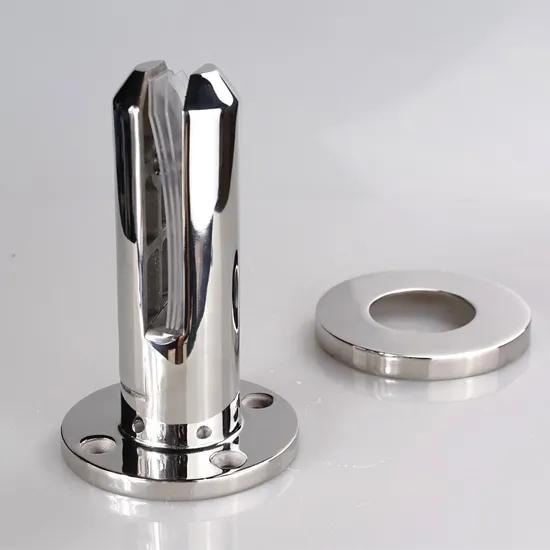
The glass railing spigot vs standoff question comes down to how the panel meets the structure: a spigot clamps the glass at its bottom edge, while a standoff fixes it through drilled holes at discrete points. Both deliver the frameless, transparent look wanted on balconies, terraces and stairs, but their load paths, adjustment, drilling pattern and cost differ.
In short: spigots seat the panel along its lower edge in a clamp shoe; standoffs project from the substrate as bolted pins holding the glass face-to-face. The choice depends on the substrate, whether the glass can be drilled, the sightline wanted, and the design load case. See our railing & balustrade hardware collection and the overview of glass balustrade systems for context.
Spigot Base Fixing: The Panel Sits in a Shoe
A glass railing spigot is a clamp-style base fitting that stands on the substrate and grips the panel’s bottom edge in a shoe. Models are stainless steel bodies with a slotted clamp opening, an adjustable bolt, and a flange drilled for anchors into concrete, steel or timber. The edge drops into the slot, a gasket separates metal from glass, and the bolt is tightened to the supplier’s torque value.
Because the fixing acts along the bottom edge rather than through a hole, the panel needs no drilled face holes. Load travels from the panel into the clamp shoe, then through the flange into the anchors. Spigots are spaced by panel width and the engineered load case, leaving compact fittings under clear glass for a near-floating look.
On-site adjustment is limited but practical: clamp tightness and, on some models, small levelling corrections are possible before final torque. Anchor and torque values follow the manufacturer’s data, never an estimate.
Standoff Fixing: Point-Bolted Pins on the Glass Face
A standoff — also called a point fixing or through-bolt pin — is a short support that bolts through a pre-drilled hole in the glass and anchors into the substrate behind. A rubber collar and finish cap sit on the visible face, so metal never bears directly on glass. Panels are held at two, three or four points per bay, with gaps between panels and no clamp along the bottom edge.
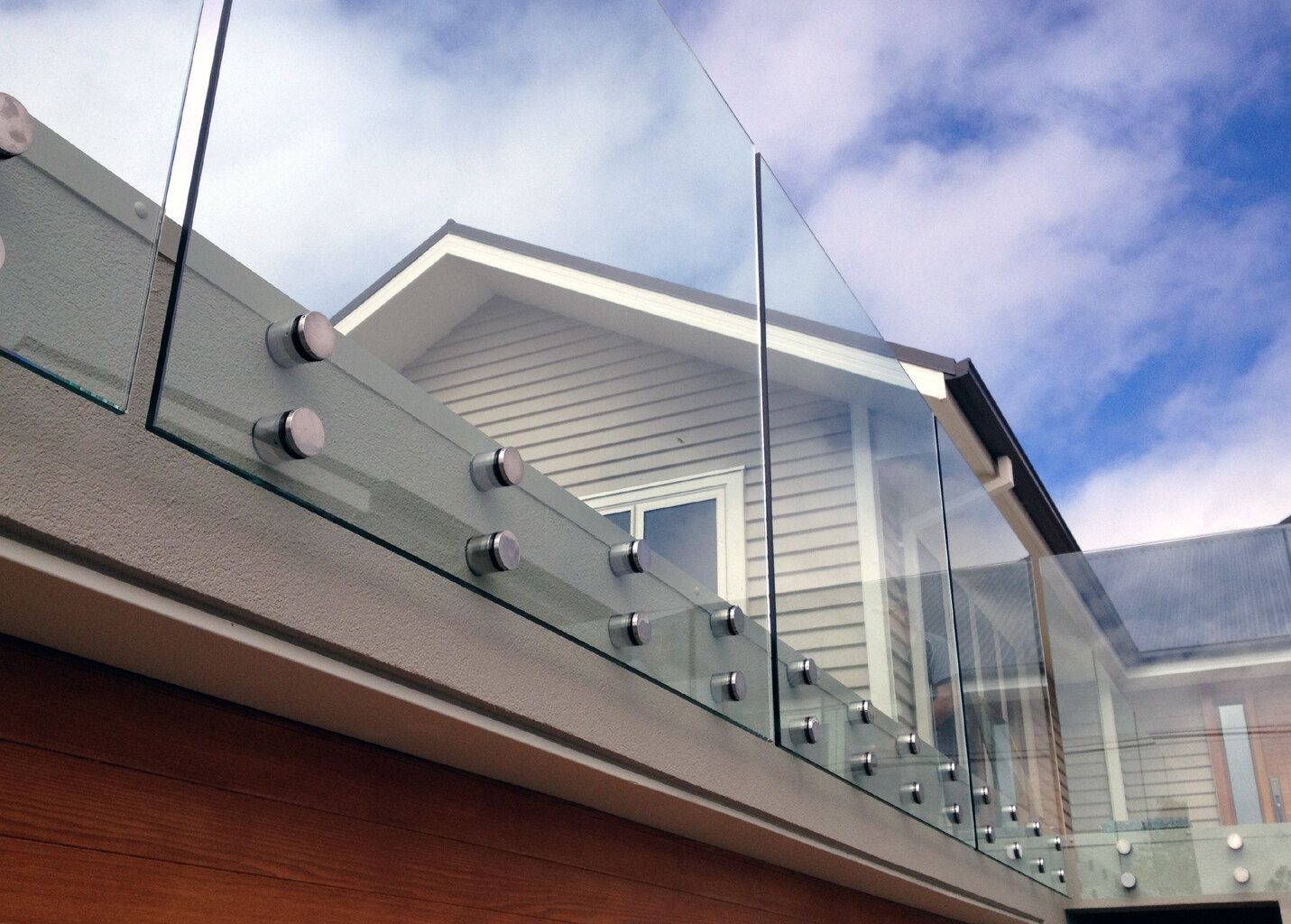
The load path runs from the panel through the drilled point, into the standoff body, and into the backing anchor. Because the panel hangs from discrete points rather than resting on a shoe, standoffs give a lighter, floating appearance with visible caps on the face. They suit side or fascia mounting against walls and deck edges where a base shoe cannot sit flat.
Standoffs offer alignment flexibility: positions can be fine-tuned against the wall before holes are finalized, and many bodies accept small lateral adjustment. The trade-off is that glass must be drilled at supplier-specified locations, so the pattern is fixed at fabrication rather than adjusted on site.
Spigot vs Standoff: Side-by-Side Comparison
| Criteria | Spigot (Clamp Shoe) | Standoff (Point Pin) |
|---|---|---|
| Fixing principle | Clamps the panel’s bottom edge in a shoe | Bolts through drilled holes at points on the glass face |
| Glass drilling | No face holes; edge sits in the slot | Holes drilled at supplier-specified positions |
| Load path | Panel edge into shoe, then flange and anchors | Panel through each point, into body and backing anchors |
| Appearance | Low-profile fittings under the panel | Visible point caps; light, floating look |
| Adjustment | Clamp tightness and small levelling | Position tuning before drilling; limited after fabrication |
| Mounting surface | Sits on a horizontal base: deck, slab, coping | Suits side, fascia or wall mounting |
| Typical uses | Terraces, decks, pool fences, parapets | Walls, fascia, stair sides, feature balustrades |
| Main cost drivers | Hardware count along the base; slab anchors | Drilled glass plus point hardware and anchors |
How to Choose: Decision Criteria
Mounting surface first. If the glass rests on a horizontal slab, deck edge or coping, a spigot shoe sits flat on the base and is the natural solution. If the panel stands beside a wall, fascia or side stringer with no shelf beneath it, standoff pins anchored into the backing structure are usually the cleaner answer.
Drilling and glass spec. Standoffs require toughened safety glass drilled at exact positions, so the panel is fabricated to a fixed hole pattern. Spigots clamp the edge and avoid face holes, simplifying replacement where drilling tolerance is tight. Confirm thickness, toughening or laminating, and hole detailing with the processor and supplier.
Sightline and environment. Spigots hide at the base for a near-floating panel; standoffs announce themselves with visible caps. Both come in stainless steel: 304 suits most inland projects, while 316 is safer for coastal decks, pools and exposed sites — match the grade to the location using supplier data.
Not sure which fits the run? Browse the railing & balustrade hardware range and read our guide to choosing glass railing posts, which covers how post-and-panel systems differ from fully frameless base fixing.
Installation and Load-Path Considerations
Whatever the fixing type, the substrate decides the anchor. Expansion or chemical anchors into concrete differ from screws into timber or welded steel; pull-out performance must match the design barrier load, sized per local code rather than one universal figure. Leave thermal movement room at joints, use gaskets at every glass-to-metal contact, and torque every fitting to the supplier’s value.
For exposed outdoor runs, drainage and corrosion matter: water trapped in a spigot slot or behind a standoff collar accelerates staining, so detail weep and gasket arrangement with the supplier. Compare both routes against your run length; our breakdown of how much a glass railing system costs shows where hardware, glass and installation spend land.
Spigot vs Standoff FAQ
Can I use spigots and standoffs on the same railing? Yes. Projects often mix them — spigots along a deck edge on a slab, standoffs on a return panel to a wall — provided each section’s load path is engineered separately.
Which gives the floating look? Standoffs read as the most open because the panel hangs at discrete points with no base shoe; spigots also look clean but show a row of fittings along the bottom edge.
Do standoffs require holes in the glass? Yes. The panel is drilled at the supplier’s positions for the point bolts, and edge distance and thickness follow the processor’s rules. Spigot shoes clamp the edge without drilling the face.
Which is cheaper for a terrace? On a horizontal deck with slab beneath, spigots avoid drilled-glass cost and simplify install; on a wall or fascia run, standoffs remove the need for a built base. Price both using supplier data.
Can standoffs be adjusted after the glass is made? Within a small tolerance only; because holes are cut at fabrication, major repositioning means new panels. For coastal or pool-side exposure, specify 316 stainless; 304 suits inland, sheltered projects — confirm grade with the supplier.
Comparing a spigot run against a standoff layout? Send the drawings and dimensions to our team for a hardware schedule sized to the load case — contact Trilonum for a spigot and standoff quotation.
Beyond base fixings, our full glass balustrade vs metal railing comparison helps choose the railing system itself.
